Call it what you will, an artificial afterlife, post-life memory care, a Google-L11-God complex, or about time there was an honest-to-AGI seastead.
There seems to not be any organizations, to use a term I learned from John L. Pollock, 'backward chaining' from the post-upload objective state towards good luck first response. This sort of planning algorithm involves backtracking on preconditions iteratively as opposed to forward propagating postconditions. They meet in the middle at instrumental robots of all sorts and sizes.
I think there are a couple problems with a fully-forward planning approach to WBE.
First, is that it is likely to be the case that uploading is much more expensive than preservation, but plausibly equal or less as there is a longer compounding investment and the investment remains honored within a civilization that both survives and continues to advance.
Revival introduces recurring memory and compute hardware costs which would likely be greater than preservations' method maintenance.
It would be quite an ironic tragedy to upload only to then become uneconomical, or through accidents, cybersecurity, etc 'die' because the original brain was destroyed and the visual data was not stored because it was extracted to a smaller data structure model during the scan, and the storage medium was not renewed or backed up, essentially. People tend to think that uploads cannot die because they can make backups. It is true that they could and would, but backups would introduce recurring costs or identity theft risks that could make life more difficult for ems.
Second, is that it is more likely that some data about a brain may be lost forever because we didn't know it was part of the requirements for sufficiency.
From what I understand, there are organizations working on microscale connectomics like Google and Allen Institute: but it seems like this is just more forward oriented pathfinding. The most important kind sure, but not the only time-direction. Eon Systems obviously has their 3D architecture pitch representing a sphere-and-cylinder insect-sized-tree afterlife for flykind.
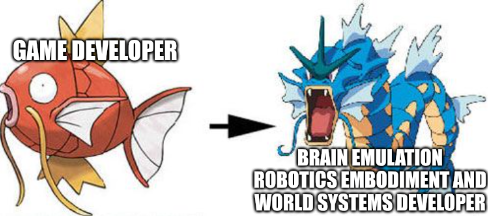
I tend to believe the best path is focused on auxillary instrumental goals: particularly to build a successful game studio that creates high-fidelity world simulations with integrated algorithmic methods, applies game development software to invention and operation of robot fleets, and eventually designs and builds its own computer hardware for the endgame.
Current game studios generally tend to focus on entertainment, which has recently caused a lot of strife in the American industry as it naturally saturates in a zero-sum game, and therefore cripples the potential gargantuan money making potential of a more advanced game development market that works in the physical world.
Feel free to correct me if I'm missing something.
Thoughts on The Afterlife Industry
-
jordansparks
- Site Admin
- Posts: 354
- Joined: Thu Aug 27, 2015 3:59 pm
Re: Thoughts on The Afterlife Industry
I think the cost of uploading will gradually drop. This means that people who are impoverished will just have to wait a little longer. I think there will be enough charities and enough friends of friends that we will eventually get everyone. In fact, this could be a very rewarding career for many people that could go on for decades. It would be a push to finish the job.
Backups should be really cheap. Life would be difficult for EMs? Who cares? Life is difficult now. We currently undergo constant tremendous data loss on a daily basis. Of course we will continue to suffer data loss, including during an upload. The idea is to hopefully start reducing some of that data loss. But you probably don't really want to remember every single little irrelevant nitpicky detail forever. I think there will always be choices on which data to keep and which data to let go of. I can see people wanting to hoard large amounts of mostly useless data if the cost is low enough.
Yes VR development will obviously become more and more important. That's where we will spend most of our time. Zuck was right about the tech but wrong about the timing. And yes, building hardware is the end game. As we move inevitably toward nanotech, the way hardware gets built will change. Right now it takes a massive global supply chain and millions of people working together. I feel like that could change to the point where each person could build their own hardware all alone. That's a very long time from now. A "person" would be so much bigger by then that the individual would probably be more complex than that entire chip manufacturing chain.
Backups should be really cheap. Life would be difficult for EMs? Who cares? Life is difficult now. We currently undergo constant tremendous data loss on a daily basis. Of course we will continue to suffer data loss, including during an upload. The idea is to hopefully start reducing some of that data loss. But you probably don't really want to remember every single little irrelevant nitpicky detail forever. I think there will always be choices on which data to keep and which data to let go of. I can see people wanting to hoard large amounts of mostly useless data if the cost is low enough.
Yes VR development will obviously become more and more important. That's where we will spend most of our time. Zuck was right about the tech but wrong about the timing. And yes, building hardware is the end game. As we move inevitably toward nanotech, the way hardware gets built will change. Right now it takes a massive global supply chain and millions of people working together. I feel like that could change to the point where each person could build their own hardware all alone. That's a very long time from now. A "person" would be so much bigger by then that the individual would probably be more complex than that entire chip manufacturing chain.
Re: Thoughts on The Afterlife Industry
It's true that data loss is part of life if you're not a Borg (backup software) cyborg, especially if you get hit by the big one (I hope the brain vats have some padding to ride out a 10 without getting nasty concussions!).
I was initially drawn to chemical biostasis, to Sparks, over cryonics based on an analogy that I heard from Aurelia Song, which is that cryonics could be like a blurry CD: were it just a little bit less blurry, it would make all the difference in reading ALL of the data representation. And of course, the same is true for first response times: there's a time that's too long and not just linear data loss anymore. I believe that hour 2 (out of ice) is about the end of hope of survival!
I wonder if that analogy still propagates through aldehyde preservation methods and some grounded living measurements of each individual are desirable or if a generic guy's temporal model is good enough to interpret the connectome like a Rosetta stone.

It would be an extraordinary benevolent and competent organization that could do the great work of pulling poor peoples' grey matter over to the other side, I think that some subset of civilization will get there.
I'd love for the first charity patients to see the new world in 1000 years and for me to see it a few or-bits sooner. But geez, not before somebody else has derisked upload!
I was initially drawn to chemical biostasis, to Sparks, over cryonics based on an analogy that I heard from Aurelia Song, which is that cryonics could be like a blurry CD: were it just a little bit less blurry, it would make all the difference in reading ALL of the data representation. And of course, the same is true for first response times: there's a time that's too long and not just linear data loss anymore. I believe that hour 2 (out of ice) is about the end of hope of survival!
I wonder if that analogy still propagates through aldehyde preservation methods and some grounded living measurements of each individual are desirable or if a generic guy's temporal model is good enough to interpret the connectome like a Rosetta stone.
It would be an extraordinary benevolent and competent organization that could do the great work of pulling poor peoples' grey matter over to the other side, I think that some subset of civilization will get there.
I'd love for the first charity patients to see the new world in 1000 years and for me to see it a few or-bits sooner. But geez, not before somebody else has derisked upload!